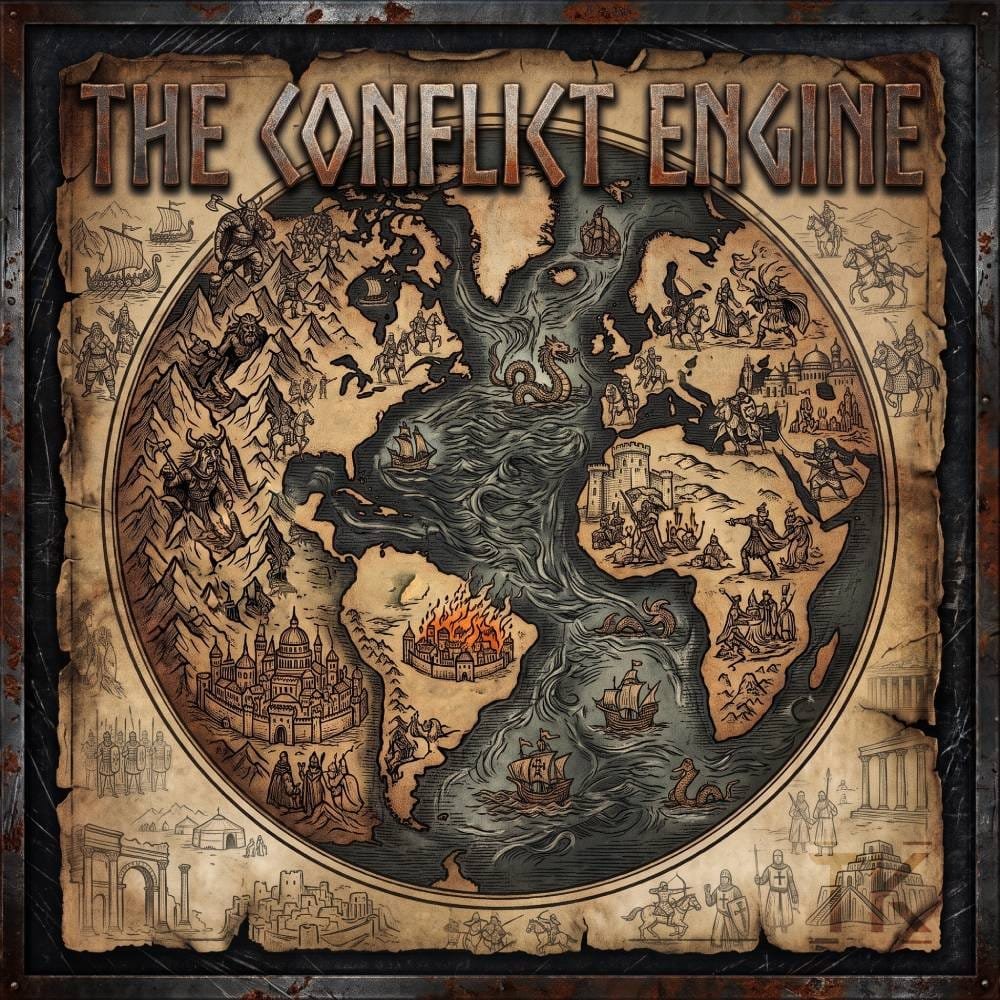
The Conflict Engine explores the brutal, inescapable cycle of human history. Drawing heavy inspiration from historical sociologists like Ibn Khaldun, the album examines the eternal, violent clash between the “hardened” periphery and the “decadent” center of civilization.
The core concept of the album rests on a historical inevitability: wealthy, fertile, and technologically advanced empires eventually grow complacent. They build opulent cities, cultivate high art and philosophy, but inevitably lose their martial edge, becoming reliant on mercenaries and walls for defense. Meanwhile, existing just outside their borders—in freezing steppes, arid deserts, dense dark forests, and oxygen-starved mountains—are tribal societies forged by absolute scarcity. Hardened by starvation and constant warfare, these nomadic and mountainous peoples look upon the wealthy lowlands and realize their masters are soft.
The album charts the turning gears of this “Conflict Engine” across different continents and eras. Each track highlights a specific historical manifestation of this cycle:
The Germanic tribes shattering the illusion of Eternal Rome.
The nomadic horse-lords of the Eurasian Steppe conquering the agrarian Chinese dynasties.
The Bedouins erupting from the Arabian Empty Quarter to crush the exhausted Byzantine and Persian empires.
The hardened Afghan warlords sweeping through the Khyber Pass to conquer the wealthy Indian plains.
The brutal descent of the Mexica (Aztecs) from the northern deserts into the lush Mesoamerican valleys.
The apocalyptic Mongol sack of Baghdad, destroying the intellectual zenith of the Islamic Golden Age.
Musically, the album mirrors this clash by violently colliding ancient, culturally specific folk instruments—from the Celtic Carnyx and Aztec Death Whistle to the Afghan Rubab and Arabic Qanun—with the crushing, modern weight of atmospheric doom and cinematic power metal.